
Age is no barrier to expanding our knowledge and horizons – HKA’s Architectural Technologist Scott Wood is proof of that.
In 2025, at the age of 59, Scott embarked on a three-year MSc in Green Building studies, to develop a deeper understanding of sustainability in construction.
Scott has never let age be a barrier to learning.
Aged 48, after over 30 years as a builder, he set his cap at a career in architecture and headed to Sheffield Hallam University to study for a degree in architectural technology.
He ran his construction business while studying part-time for four years and achieved his goal aged 52.
He joined HKA as an architectural technologist, bringing masses of added value – skills and qualifications in a wide range of construction disciplines.
Having continually sought education throughout career, Scott has NVQs in Bricklaying, Roofing and Cladding, a Sub-diploma in Construction in the Built Environment and a HNC with distinction in Construction In the Built Environment.
After being with the practice for eight years, Scott has decided to push himself further.
His distance-learning Green Building studies with the Wales-based Centre for Alternative Technology will give him an in-depth understanding of sustainable design principles and how to apply them, best-practice construction methods and standards, and socially and ecologically-responsible practices.
Says Scott: “Getting a Masters has been on my mind for a while. It’s a big thing to undertake, especially as my HKA role is full-time. But it’s a subject I am very interested in and I’m used to learning in later years. In fact, I’ve missed studying; my mind had started to get restless!”
The Green Building course focuses on sustainable building design, construction and renovation. It aims to equip students with critical-thinking skills so they can integrate green building principles into their work and help the built environment to adapt to climate change.
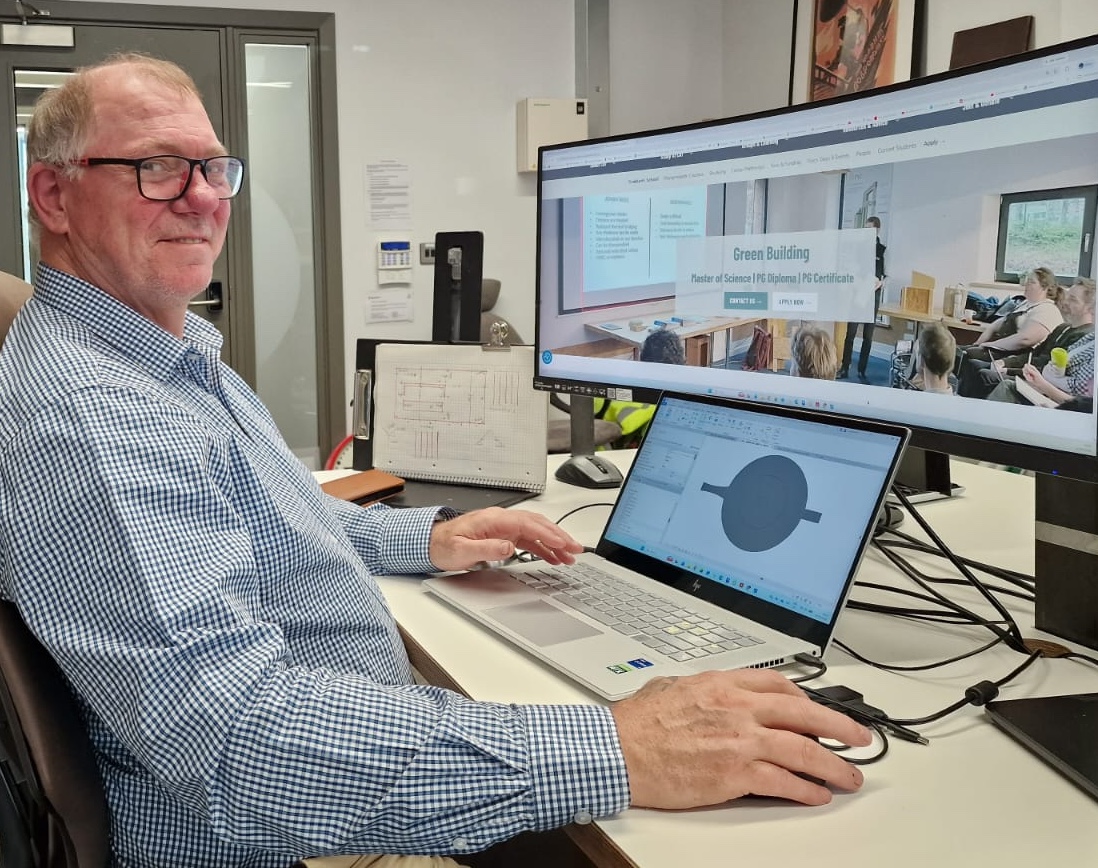
Says father-of-four and grandfather Scott: “When I was a builder, global warming and sustainability weren’t much talked about and the main concern for clients was how to keep the cost down.
“It’s now widely accepted that climate change has to be addressed by the construction sector. We currently have a linear-based construction industry – materials are manufactured, used and thrown away. We need to work with materials which are sustainably-sourced or can be recycled.
“The effects of climate change on the buildings we create or maintain also needs greater attention. The sector must make them comfortable and safe for the people who live or work in them, with solutions such as thermal efficiency, green energy sources and waterproofing and preventing heat overloading through passive-design strategies such as orientation, shading, glazing, ventilation and thermal mass.”
Scott believes his qualification will add another specialist string to the HKA bow – the retrofitting of old housing stock to bring them up to a modern level of human comfort, and reducing energy inefficiency by intelligent design.
He added: “It will make us more informed regarding material choice and lead us to favour sustainability, reusability, longevity and locality over price and convenience and will help us provide clients with informed recommendations for a sustainable construction approach.”
Some of the topics Scott is studying:
- Advanced building analysis and construction techniques
- Heat and moisture flows in buildings, zero carbon building standards, and methodologies
- Circularity applied to building project management and the building project life cycle.
- Environmentally-responsive materials, resources, and life-cycle analysis/environmental assessment
- Acute resilience pathways for cities and communities
- Renewable energy systems
- Biodiversity enhancement in buildings and cities and ecosystem services provision

